January 8, 2026 · KAEVO
Lion's Mane dosage: how much per day, and when
Most Lion's Mane bottles tell you how many capsules to take. They don't tell you what the research actually used. Here's the dose, the form, and the timing, minus the marketing.
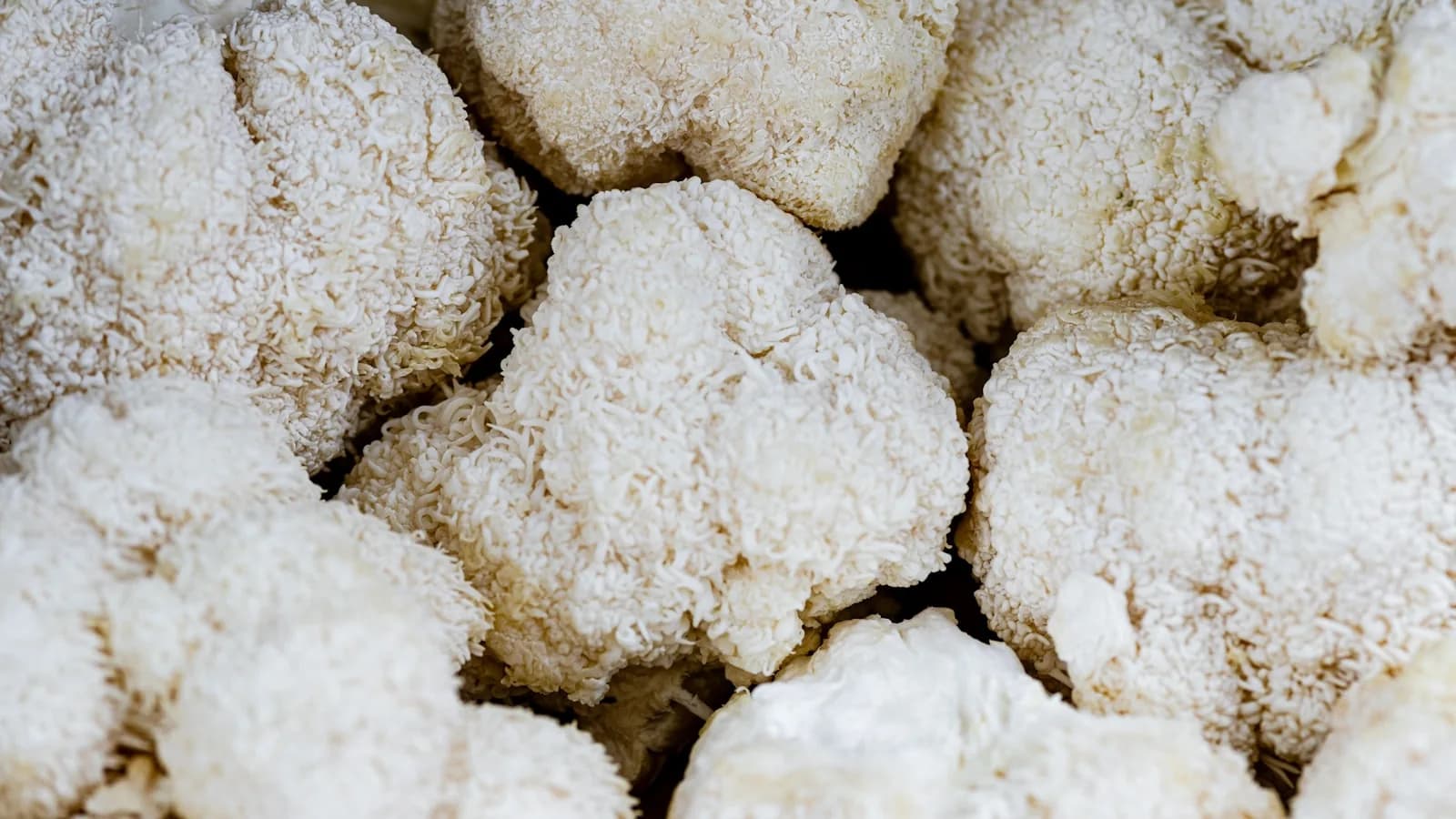
The first time most people buy Lion's Mane, they end up squinting at two bottles in the supplement aisle, reading the back labels, and getting nowhere. One says "take one capsule daily." The other says "take three capsules with food." The total milligrams aren't on the front of either of them. Both bottles cost more or less the same. Neither tells you what the actual research said about the dose that produced an actual effect.
This is the weird thing about Lion's Mane. It's one of the most-studied mushrooms in the nootropic space, with peer-reviewed trials going back almost two decades. And yet the consumer experience is mostly vibes. Capsule counts that don't match research doses, "fruiting body" and "full spectrum" labels that obscure how much actual extract you're taking, and timing advice that varies wildly depending on which Reddit thread you land on.
The good news is that the actual research is straightforward, the dose isn't a secret, and the timing question matters much less than people think. Once you know what to look for, picking a Lion's Mane routine that does what the studies showed it can do takes about ninety seconds. The hard part is the bottle, not the routine.
Why Lion's Mane is harder to dose than it should be
Most supplement categories converge on a "standard" dose within a few years of clinical research. Magnesium glycinate has settled around 200 to 400 mg before bed for sleep. Creatine has settled at 3 to 5 grams daily. Lion's Mane never quite did, partly because the underlying biology is interesting and partly because the supplement industry has been slow to standardise.
The doses on bottles vary so wildly for two reasons. First, Lion's Mane is sold in two fundamentally different forms, fruiting body extract and mycelium-on-grain, and one gram of one is not equivalent to one gram of the other. Second, the active compounds are concentrated through extraction, so the same gram of "Lion's Mane" can contain very different amounts of the things that actually do something. A bottle saying "1000 mg per serving" can mean anything from a real, concentrated dose to mostly grain with trace amounts of mushroom on top of it.
The clinical research is more disciplined than the marketing. The trials that produced cognitive or mood effects almost all used fruiting body extracts at specific milligram doses, given for a specific number of weeks. That body of work gives you a defensible target.
What the research actually tested
The most-cited Lion's Mane study is from Mori and colleagues in 2009, who gave older adults with mild cognitive impairment 3 grams of dried fruiting body powder daily for 16 weeks. The active group improved on cognitive scales while the placebo group did not. Importantly, when supplementation stopped, the improvement faded over the following weeks. The dose was high (3 grams), the duration was long (four months), and the population was older adults already showing measurable decline.
A 2019 Japanese trial by Saitsu and colleagues used a similar dose, 3.2 grams of fruiting body extract daily for 12 weeks, in healthy older adults, and again saw cognitive improvement on standardised batteries. Other smaller studies have looked at mood and sleep quality at doses closer to 2 grams daily for shorter durations. The consistent thread across the well-conducted human trials is daily fruiting body extract in the 1.5 to 3 gram range, taken for at least eight to twelve weeks before the effect becomes measurable.
That's the ballpark. Below 1 gram a day of real extract, the trial evidence thins out quickly. Above 3 grams a day, you cross into territory that hasn't been studied much in humans, not because it's dangerous, but because nobody has done the work.
The fruiting body vs mycelium-on-grain problem
This is the dose question hiding inside the dose question. Lion's Mane is a mushroom; what most people picture is the white, shaggy thing that grows on a log in the forest. That's the fruiting body. But the mushroom also has an extensive root-like network called mycelium, which is invisible underground and is much cheaper to grow on a substrate of grain or rice in a lab.
If you've seen a supplement labelled "full spectrum" or "myceliated," you're looking at a product where mycelium is grown on grain, the whole substrate is dried, and the mixture is ground up. The advertised dose is often the weight of the entire mixture, grain included, which can be 60 to 80 percent of the powder. Independent testing has repeatedly shown that mycelium-on-grain products contain dramatically lower levels of the active compounds (beta-glucans, hericenones) than fruiting body extracts at the same labelled gram dose.
This matters because every clinical trial that produced cognitive effects used fruiting body, not mycelium-on-grain. When a bottle proudly announces "1500 mg of Lion's Mane per serving" but the source is mycelium-on-grain, you may be taking 300 mg of mushroom and 1200 mg of cooked oats. The mg on the label looks similar; the actual dose is not.
The fix is to read the source carefully. Look for "fruiting body extract" or "hot water extract of fruiting body." A "1:8" or "10:1" extract ratio tells you how concentrated the extract is. A 10:1 extract means it took 10 grams of raw mushroom to produce 1 gram of finished extract. If a label doesn't mention extraction or fruiting body at all, assume mycelium-on-grain and discount the dose accordingly. KAEVO Clarity sits in the fruiting-body-extract camp deliberately, dosed in the research-backed range, with the form chosen to match what actually produced effects in the trials.
When to take it
This is where most of the internet has the wrong default. The conventional advice ("take it in the morning") is fine, but the reasoning ("for cognitive support during the working day") is mostly post-hoc. Lion's Mane isn't a stimulant, doesn't activate the way caffeine does, and doesn't produce a measurable acute window of sharper thinking after one dose. The cognitive benefits in the trials accumulated over weeks, not over an afternoon.
Time of day matters less than people think. Morning is fine because most people remember morning supplements. Lunchtime is fine. Splitting the dose between morning and early afternoon is fine. There is no clinical evidence that morning Lion's Mane outperforms evening Lion's Mane. The studies all dosed once daily without specifying a time window, and one even split it across meals.
The only timing rule worth keeping is consistency. The research effect was produced by daily dosing for weeks, not by perfectly timed dosing on alternate days. If you're going to forget half the time at noon, take it at breakfast. If you're an evening person, take it with dinner. There is one mild reason to take Lion's Mane with food, which is that some of the active compounds (the hericenones in particular) are fat-soluble. A breakfast with at least a little fat in it, like eggs, avocado, or yogurt, modestly improves absorption. This is a small effect, not a make-or-break one.
What to expect, and on what timeline
This is the part most marketing skips, because honest expectations don't sell as well as miracle claims. Lion's Mane is a slow supplement. The first week you may notice nothing at all. Some people report slightly steadier mood or easier sleep within the first two weeks; others don't. The cognitive effects in the trials emerged at four weeks at the earliest and were clearer at twelve to sixteen weeks. The trial that produced the strongest cognitive scores ran for four months.
What this means is that judging Lion's Mane after two weeks is like judging a strength training programme after two workouts. Technically possible, but not informative. If you're going to try it, give it ninety days at a real dose before you decide whether it's earning its place in your routine. The other side of the coin is that the effect is reversible. The trials that included a follow-up arm without supplementation showed the cognitive gains drifted back toward baseline over the following weeks. Lion's Mane isn't fixing anything; it's supporting a process while you're taking it.
Who should be careful
A handful of people shouldn't take Lion's Mane without a conversation with their doctor first. Mushroom allergies are real, and Lion's Mane is a mushroom. If you've had reactions to other fungi, the careful move is to skip it. There is also a theoretical interaction with anticoagulant medication, since some compounds in Lion's Mane have shown mild blood-thinning activity in lab models. Pregnancy and breastfeeding are outside the trial population, so most clinicians err on the side of skipping during these phases. If you fall into any of these categories, talk to your doctor before adding it. That's a one-sentence conversation, not an obstacle.
For everyone else, side effects in the human trials have been minimal. Mild GI discomfort in a small percentage of people, occasional skin sensitivity, no serious adverse events at the doses tested.
What it stacks well with
One of the underrated things about Lion's Mane in a daily routine is that it pairs cleanly with most of the other supplements people care about. It doesn't compete with caffeine. Caffeine is acute and stimulant; Lion's Mane is slow and structural. People who take both report a steadier feeling rather than a doubled-up one, and the research on pairing them in functional coffee products has been generally favourable. If your daily focus ritual already includes a morning coffee, adding Lion's Mane is genuinely additive rather than redundant.
It also stacks well with omega-3s, which are the other supplement with serious cognitive evidence behind them. Omega-3s and Lion's Mane work through different mechanisms (omega-3s on cell membrane fluidity and neuroinflammation, Lion's Mane on nerve growth factor and neurotrophic activity) and there is no known interaction between them. Taking a fish oil capsule alongside your morning Lion's Mane is one of the cleaner stacks in the cognitive space.
Putting the routine together
If you're starting Lion's Mane next week, here is the simplest version that does the job. Pick a fruiting body extract, not "full spectrum," not "myceliated," at a daily serving in the 1 to 3 gram range. Take it with breakfast. Set a phone reminder if you're new to daily supplements; the trial effects came from consistency, not heroics. Give it ninety days before you decide whether it has a place in your routine.
If you'd rather not vet brands or read extraction ratios on labels, KAEVO Clarity is built for this exact path. The Lion's Mane fruiting body extract in Clarity is dosed in the research-backed range, in a daily two-capsule serving you take with breakfast. If you're trying to figure out where it fits alongside the rest of a daily focus routine, the bundle quiz will sort the sequencing in about a minute, and the Morning Clarity is the bundle version if you'd rather start the routine pre-built.
Lion's Mane plays well with the rest of a daily focus ritual. It doesn't compete with caffeine, doesn't interact with a daily multivitamin, and isn't a substitute for sleep. If your morning is already coffee plus breakfast, adding Lion's Mane is the smallest possible change to the day that the research has anything to say about. Once you're a month in, you'll have a clearer sense of whether it's earning the spot.
The short version
Lion's Mane works at doses the research actually tested. Fruiting body extract in the 1 to 3 gram range, taken daily, with food, for at least three months. The form on the label matters more than the milligrams. The time of day is a personal preference, not a science question. Take it consistently for long enough to know whether it's working, and stop trusting bottles that don't tell you what's inside them. Take it with breakfast. Give it three months. The boring answer is the right one.